
Monthly ‘payday’ deductions for 7 million Self-Assessment PAYE taxpayers
Monthly ‘payday’ deductions for 7 million Self-Assessment PAYE taxpayers
In a radical move, HMRC has set out plans to end twice-yearly tax bills for the seven million PAYE taxpayers inside self-assessment, with monthly ‘payday’ payments.
Following the introduction of mandatory Making Tax Digital for Income Tax for earners down to as low as £20,000 within the next two years, the direction of travel is clear with HMRC aiming for more regular, frequent in-year payments rather than the current two payments for all self-assessment taxpayers, where applicable.
HMRC is now setting out plans to change the current payment arrangements for income tax self-assessment (ITSA) taxpayers related specifically to their PAYE-related income to a system of more frequent, monthly payments, based on a percentage of overall annual earnings. This is described as ‘more timely payment’ by HMRC and will start in less than three years’ time at the start of the 2029-30 tax year.
In other words, HMRC will be collecting tax on a much more frequent basis from self-assessment taxpayers from April 2029, specifically it will change the payment timings for self-assessment taxpayers with Pay As You Earn (PAYE) income.
This measure will have a huge impact on taxpayers with an estimated seven million taxpayers already in self-assessment with PAYE income set to be affected. It will also have a significant impact on employers and pension providers, all involved in taxing some earnings at source, not to mention tax advisers and accountants, who will be inundated with questions from affected clients.
The proposals will see ITSA taxpayers with PAYE income required to pay their forecasted ITSA liability more frequently in-year from April 2029. At the moment, these taxpayers have up to 22 months to pay the tax bill from the initial taxable activity.
‘From April 2029, taxpayers will pay the first instalment of their forecasted ITSA liability for the 2029-30 tax year. Thereafter, taxpayers will pay instalments of their ITSA liability each payday,’ HMRC consultation states.
‘Payday’ is defined in the consultation as being ‘divided into equal payments through the year’, effectively equal monthly instalments of 8.3% of the individual’s annual total HMRC estimated tax bill.
In the first year of operation, taxpayers will be hit by two years of tax liability in a single year.
The in-year payments will also raise issues for affected taxpayers with seasonal or irregular income, but HMRC stated ‘they will be able to update their forecast, and their required payments will adjust accordingly’.
HMRC added: ‘The circumstances of this group will be carefully considered in the design of payment timings and any associated easements or safeguards.’
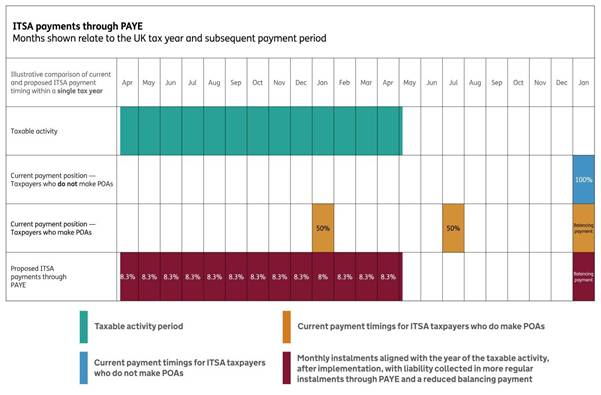
There will clearly be a major burden during the transition to the new rules as affected taxpayers will effectively be having to pay two lots of tax in a single tax year. The government acknowledged ‘there will be an adjustment period whereby liabilities due under the new payment schedule will be paid alongside those due under the existing payment schedule’.
Coming at the same time as the upheaval of quarterly reporting under MTD for Income Tax, the latest proposals will mark a radical overhaul of the current tax system for taxpayers under self-assessment.
The proposed reforms ‘will not increase the amount of tax due,’ HMRC stated, but will ‘bring the timing forward so that tax is paid closer to when the income is earned’.
Payments will be forecasted by HMRC, based on past self-assessment returns, with taxpayers able to update their forecasts.
Under the new system, taxpayers will report their actual liability and reconcile their payments with a balancing payment, or repayment from HMRC, when they complete their self-assessment return.
This creates complexity for employers as HMRC said under the proposals ‘they may deduct more tax from some of their employees each payday because of the inclusion of forecasted ITSA liabilities’.
Employers will also have to deal with multiple changes to tax codes, which HMRC also needs to consider.
Transition needs to be thought through carefully as it could present cashflow challenges to taxpayers, even as it helps the government with theirs. Income tax payments will be estimated based on the last submitted tax return, raising questions about how these changes align with the longer-term direction of Making Tax Digital.
The government is also reviewing safeguards for low earners who may not be able to lose more of their income by automatic deduction due to HMRC’s ITSA tax assessment affecting their PAYE income.
Payment alignment and a shift to real time reporting have been a long-held aspiration of the Treasury and HMRC ever since real time information reporting came in.
Payment on account also up for review
In addition, HMRC is looking to review the payment on account (POA) rules from the current two payments a year to a possible three or four payments a year from April 2029. HMRC would forecast tax liability for the forthcoming year, with a balancing payment for the taxpayer, but is looking for views on whether this would work.
This very brief HMRC consultation runs for six weeks only and outlines a radical overhaul of the ITSA payment arrangements. The idea was first proposed in papers released in the 2025 Budget.
In the latest consultation, HMRC claimed: ‘Spreading tax payments through the year into smaller, regular payments will help reduce tax debt and avoid taxpayers having to pay larger, infrequent and sometimes unexpected bills.’
A decision on next steps will be taken after consultation responses are reviewed, with a response due in autumn 2026, effectively before the next Budget.